What My Great-Grandfather Taught Me About Genealogy, Gravestones & the Power of Local Knowledge
Gravestones are extraordinary resources for family historians. They hold dates, names, relationships, stories… and sometimes, they hold the breakthroughs we’ve been searching for decades.
But when the person you’re looking for has a very common name — like my great-grandfather, James McQuillan — the trail can become frustratingly cold.
For years, I knew almost everything about James: where he lived, worked, married, and raised his family. My professional background as a librarian and local studies specialist meant I had the tools to uncover the paper trail of his life.
Except one thing:
I could not find where he was buried.
A Family Story… and a Mystery…
Family stories told me James wasn’t buried with his wife — it had been a mixed marriage, and Catholic/Protestant burial customs were still strict at the time. My mum believed he was resting at St Mary’s, Drumagarner, just outside Kilrea.
You’d think she would know — it was her grandfather, after all — but she was only twelve when he died.
So off I went:
✔ Walked the graveyard
✔ Checked every McQuillan headstone
✔ Searched Find a Grave.com
✔ Tried “James McQuillan,” “McQuillan,” “Kilrea,” and every spelling variation
Nothing.
No James. No marker. No clue.
I began to wonder if the family had simply been too poor to place a headstone.
The Problem With Find a Grave (And Why You Shouldn’t Give Up)
Find a Grave can be an incredible resource — but its search feature can be… let’s say, temperamental.
Here’s what happened in my search:
- Searching “County Londonderry” didn’t help
- Searching “Aghadowey” returned nothing (Find a Grave didn’t recognise that place name in its main search)
- Searching by date didn’t help
- Searching by cemetery didn’t help
- Searching by his exact name also didn’t help
It wasn’t that James wasn’t there.
It was that he wasn’t indexed where I expected him to be.
This is a situation so many beginner researchers face — they assume “No results” means “they aren’t buried there.” But often it just means the record is labelled differently, listed under a neighbouring townland, or hasn’t been transcribed fully.
And this is where expert knowledge becomes invaluable.
The Breakthrough: A Chance Conversation
One day, I mentioned my brick wall to a local historian friend — someone who has spent years transcribing graveyards in the area.
Within minutes, he said:
“James McQuillan? I think he’s buried in Aghadowey” — then dropped in “… Find a Grave lists the chapel under Coleraine.”
Bingo.
In the Church of Our Lady of the Assumption, labelled under Coleraine, I finally found him — buried not alone, but with his brother and his family.
The Headstone That Closed the Circle
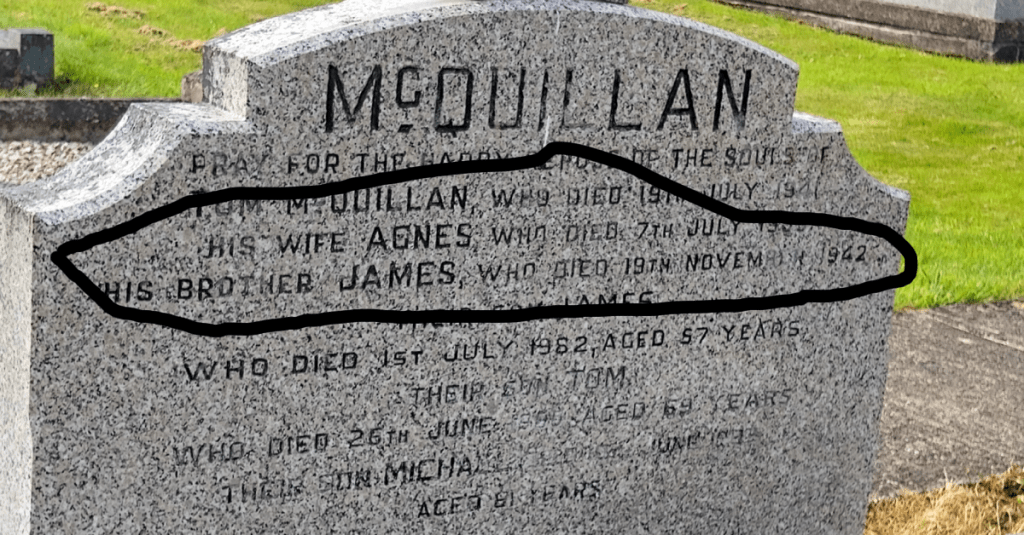
Here is the inscription that brought James home to me:
McQUILLAN
Pray For The Happy Repose Of The Souls Of
TOM McQUILLAN, Who Died 19th July 1941.
His Wife AGNES, Who Died 7th July 1969.
His Brother JAMES, Who Died 19th November 1942.
Their Son JAMES,
Who Died 1st July 1982, Aged 57 Years.
Their Son TOM
Who Died 26th June 1990, Aged 69 Years.
Their Son MICHAEL, Died On 30th June 1993
Aged 61 Years.
I later learned that several other relatives are buried at this chapel too, in unmarked graves. I hope to mark their resting place soon, so they are no longer forgotten.
It was emotional to finally stand at James’ grave — to know him, honour him, and connect those generational threads for my family.
Tips for Using Find a Grave More Successfully
If you’ve tried Find a Grave and felt frustrated, you’re not alone.
Here are practical tips (learned the hard way!) that make a huge difference:
- Try multiple place-name variations
Cemeteries may be listed under:
- A nearby town
- A larger postal district
- A historic parish name
- The diocese, not the village
Example: Aghadowey → Coleraine.
- Leave location fields blank and search only the name
This can bring up unexpected burial places you’d never think to try.
- Use wildcards
McQuillan*, Mc Quil*, *Quillan, M’Quillan
Spelling variations across history are wildly inconsistent.
- Search siblings, spouses, or children instead
Often entire family groups appear on one headstone — and the person you’re searching for is listed at the bottom.
- Check “Burial Unknown” entries
Many users create memorials without knowing the cemetery. A match may appear here long before a headstone is added.
- Use Google with site search
Google can sometimes finds things faster than Find a Grave’s internal engine:
- Don’t rely on Find a Grave alone
Cross-reference with:
- local history groups
- church office records
- gravestone transcription projects
- newspaper death notices
- neighbouring graveyards
- local genealogists / historians (this is how I found James!)
Why Expert Help Still Matters
Online tools are powerful, but they have limits.
My great-grandfather’s burial place wasn’t found through databases — it was found through:
- Local knowledge
- Community connections – simply talking to the right person!
- Years of built-up professional experience
- Knowing where “the hidden information” tends to live
This is exactly what professionals bring to their clients:
the shortcuts, the networks, the context, the intuition, and the ability to read between the lines.
Closing Thoughts
Finding James felt like finally lighting a candle in a corner of my family’s history that had been dark for too long.
His story reminded me that:
- online tools are helpful but imperfect
- gravestones remain some of our most valuable historical documents
- sometimes the key to a mystery is the person sitting across from you!

 Ulster Origins
Leave a comment