
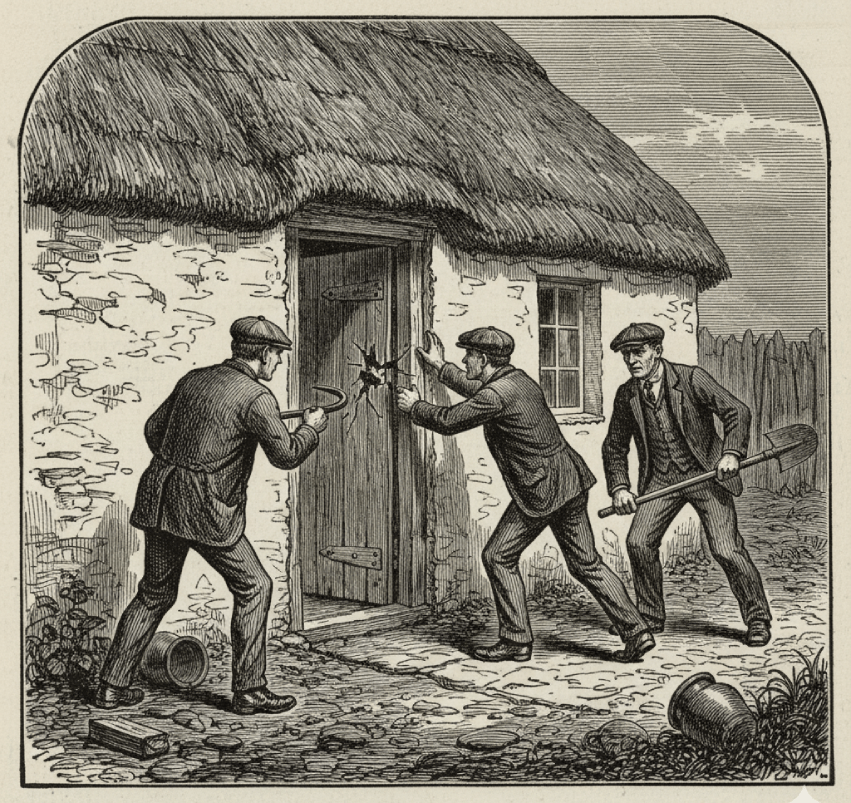
On a July morning in 1881, just after half past five, the quiet of the Herald household was broken by an attempted seizure of goods over a debt of £4 16s — a not insignificant sum, but one that would soon spiral into violence, courtrooms, and prison sentences.
John Herald and his wife Mary Ann lived with their children at Aghadowey. On that morning, a bailiff named Neal Curry, accompanied by Hugh Toye and his nephew John Kennedy, arrived to enforce a civil decree obtained by Toye. The door, by all accounts, was not locked. What happened next depends very much on who was telling the story.
A Dawn Raid Gone Wrong
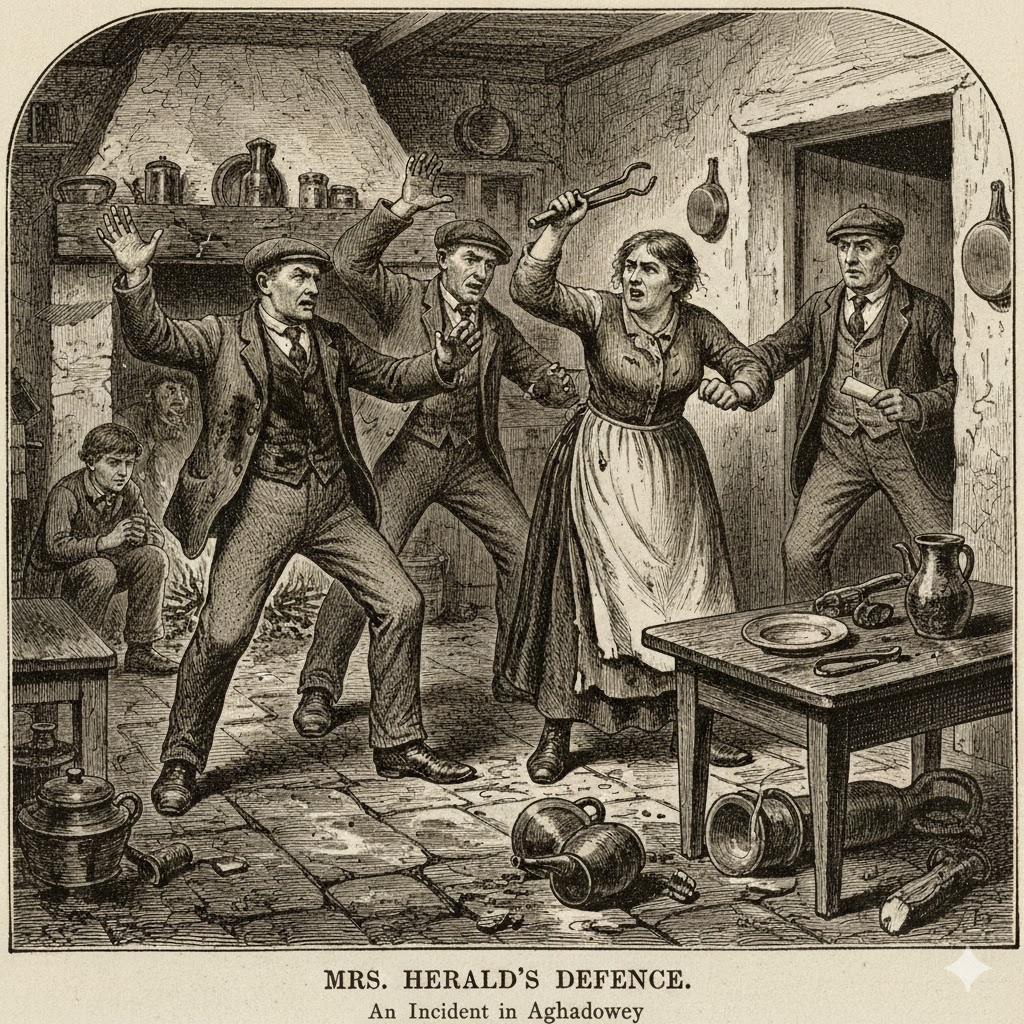
According to Curry, once inside the kitchen and in the middle of listing goods for seizure, Mary Ann Herald suddenly threw the contents of a teapot over him — scalding hot. He claimed he was then struck with a crook by John Herald, while Toye was also attacked. There were “a lot of young people” present, and the household was only partially dressed.
Under cross-examination, Curry admitted he had previous fines and acknowledged “a failing” — a phrase that raised knowing laughter in court. He described the scene as chaotic and memorable, if not dignified:
- the parents partly dressed,
- one boy naked,
- another in a shirt,
- general confusion following the unexpected entry at dawn.
The court found this amusing. The Herald family very likely did not!
Escalation and Injury
Hugh Toye told a more dramatic version. He claimed Mary Ann struck him with tongs, that James Herald hit him, and that he was knocked down hard enough to require medical attention three times. He insisted the bailiffs never struck back — despite later admitting he arrived carrying a spade and had previously been fined for throwing stones at the Herald home.
John Kennedy testified that Mary Ann used both a spade and tongs, that Peggy Herald struck with a crook, and that the boys choked him. He conceded, however, that his statements differed from what he had sworn previously — and that relations between the families had once been good. Notably, despite three men attending to seize goods, nothing was removed from the house at that time.
The Defence Version
The defence painted a very different picture. They argued that Kennedy had forced the door, breaking bolts and staples — a tactic described as common practice to allow bailiffs entry while avoiding responsibility. Witnesses stated that Mary Ann Herald suffered three broken ribs, Peggy was badly injured with a head wound, and the household had been violently disturbed while barely clothed.
A neighbour, Ellen Carroll, a married daughter of the householders, testified that she was woken by screams and saw Toye beating her mother with a spade while threatening to “have a life.” She said Kennedy carried a knife. She described James Herald as having “nothing on him,” and Thomas emerging in confusion from beside the fire.
Even in giving evidence, Ellen admitted she had taken time to get dressed before intervening — a small, human detail amid the turmoil.
Verdict and Punishment
Despite the conflicting testimonies and clear injuries on the Herald side, the jury returned a verdict of guilty. They did, however, recommend mercy for the younger members of the family.
The Recorder’s judgment was swift:
- John Herald was sentenced to one month in prison with hard labour.
- Mary Ann Herald received two months, with labour “suited to her sex” — a phrase that now sounds as chilling as it is archaic.
- The children were released only after £10 sureties were provided to guarantee their good behaviour for twelve months.
The judge made it clear he believed Mary Ann’s actions had escalated the situation — though one might question how calmly any mother would respond to armed men entering her kitchen before sunrise.
And with that, the court moved on.
What stands out, reading this now, is not just the violence or the imbalance of power, but the way poverty, authority, and family instinct collided — and how readily the justice system punished resistance rather than intrusion. There is tragedy here, but also moments of raw humanity: confusion at dawn, half-dressed families, tempers flaring, and a household pushed past breaking point.
Wider Social Context
In the summer of 1881, the Herald family found themselves caught in a situation that was all too common for working families in late-19th-century rural Ireland. A small debt — £4 16s — had led to a court decree allowing a bailiff to seize household goods.
This incident took place during a period when poverty, debt, and land insecurity shaped everyday life. Bailiffs were widely feared figures, and early-morning seizures were particularly traumatic, often carried out when families were most vulnerable. Resistance — especially by women defending their homes — was common, but rarely viewed sympathetically by the courts.
Mary Ann Herald’s punishment reflects the harsh expectations placed on women at the time: she was judged not only for what she did, but for failing to remain passive under threat. The family’s experience speaks to a wider pattern in which working people faced the law at its most forceful, with little room for compassion or context.
Today, this story can be read not simply as a criminal case, but as a glimpse into the pressures faced by ordinary families — where survival, dignity, and home were fiercely defended, even at great personal cost.
And why does this matter to me? John and Mary Ann Herald were my 3 x great grandparents, and the grandparents of James McQuillan in my Finding James post..
Was this kind of treatment common?
Short answer: yes — disturbingly so.
In late-19th-century Ireland, especially in rural Ulster, poverty criminalised ordinary life. Civil debt cases routinely turned into criminal proceedings when families resisted bailiffs. Once resistance occurred, the original debt almost became irrelevant — the focus shifted to order, authority, and obedience.
For working-class families:
- early-morning seizures were common
- physical resistance was frequent
- injuries were widespread
- and imprisonment was used as a deterrent, not as a proportionate punishment
The courts were far more concerned with protecting the authority of the law than with examining how that authority was exercised.
Mary Ann Herald: age, gender, and injustice
I’m still researching this family but it is possible (but not verified) that Mary Ann may have been entering her 70s at this time.
From a modern perspective, her situation is shocking:
- an elderly woman
- injured badly enough to have broken ribs
- dragged through court
- and sentenced to two months’ imprisonment with hard labour
But in 1882, the legal system did not see her as elderly or vulnerable. It saw her as:
- a householder responsible for order
- a woman who failed to remain passive
- and, crucially, someone whose actions challenged male authority
The judge’s comment — “but for whose conduct the whole affair might have been arranged” — is extremely telling. Mary Ann was not punished primarily for violence, but for disrupting the expected gender role: she was expected to submit, defer, and absorb the intrusion quietly.
Women who resisted bailiffs were often judged more harshly than men, because their resistance was framed as disorderly, emotional, or morally suspect. Despite how the courts framed it, women frequently led resistance to seizures:
They were usually at home. They defended children, beds, cooking pots, and clothing. They understood exactly what would be lost. And they had less to lose in terms of formal employment or reputation. Throwing water, wielding household tools, shouting neighbours awake — these were standard forms of protest, not random outbursts.
But the system feared this kind of resistance, because it undermined authority at the most visible level: the home. So punishment was often exemplary — meant to warn others.
Mary Ann’s imprisonment likely served as a public lesson to the community: this is what happens when you resist, even if you are old, injured, or poor.
Poverty as the real crime
It’s important to remember:
- The original debt was £4 16s
- No goods were ultimately seized that morning
- The family ended up with injuries, prison sentences, and public shame
This pattern appears again and again in newspapers of the period:
- small debts ballooning into court cases
- families punished far beyond the value of the money owed
- neighbours drawn in as witnesses
- long-term damage done to already fragile households
Poverty was treated as moral failure, not misfortune. Once a family entered the legal system, they rarely emerged unscathed.
Why this story matters now
What makes Mary Ann Herald’s story powerful is that it exposes:
- how law and poverty intersected
- how women’s resistance was punished
- and how the justice system often protected property over people
Seen through this lens, Mary Ann isn’t a troublemaker or instigator — she is a woman defending her home under impossible conditions, in a system that offered her no safe choices.
What the Court Record Doesn’t Tell Us
What the court record doesn’t tell us is what it felt like to be on the other side of the door. It does not record the shock of men entering a kitchen at dawn, the fear of losing the few household goods that kept a family going, or the instinctive response of a woman who had lived a long life shaped by hardship.
Mary Ann Herald may have been in her seventies, and the record’s silence on her age and injuries is striking. Her broken ribs appear only as an inconvenience to the proceedings, not as evidence of vulnerability or harm.
The language of the court frames resistance as disorder and blame, but it does not ask whether submission was ever a realistic option. What is missing is the understanding that, for poor families, the home was often the last line of defence — and that defending it could carry a terrible cost.



 Ulster Origins
Leave a comment