
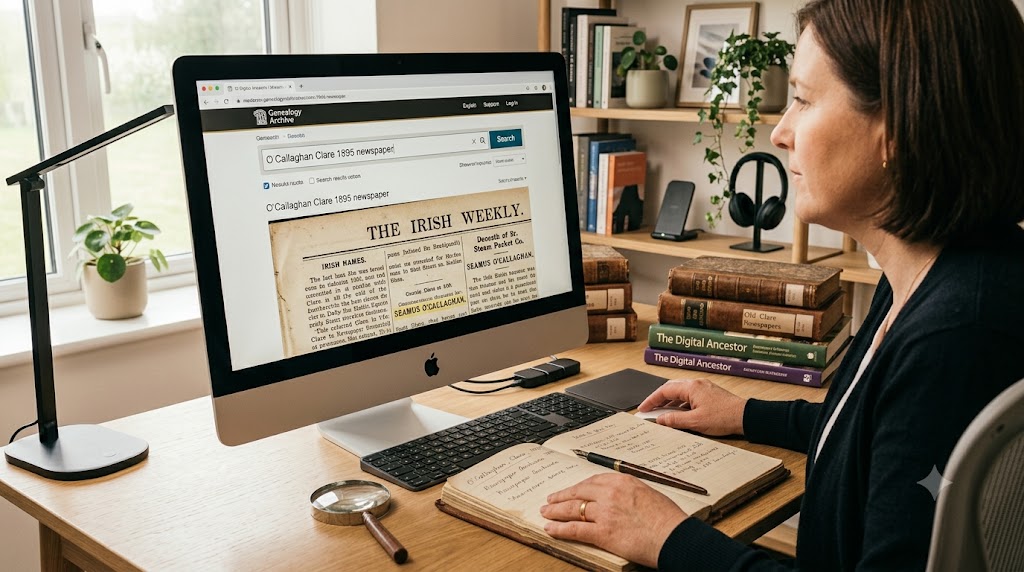
I found details of my three-times great-grandparents John and Mary Ann Herald and some of their family because a bailiff got a teapot of scalding water thrown over him! What was your great-grandfather laughing at over breakfast? Which neighbour was arguing over a boundary wall? Did your ancestor ever write a letter to the editor? Report a stolen horse? Win a prize at the local agricultural show? Newspapers preserve moments like these—not because anyone expected them to become family history, but because they were simply part of everyday life.
My Heralds weren’t in a church register or on a certificate, but in a newspaper, where a barrister’s cross-examination was recorded almost word for word, laughter and all, one Saturday in April 1882. Most of the family had been born pre-registration, or not registered, so finding them was a tad challenging. I tried searching for some townlands I thought John and Mary Ann had lived in and bingo… With this article, I got a very brief glimpse into their lives.
That is what newspapers give you that no certificate ever will: not the fact of a life, but the more rounded texture of one. And the best thing about it is that most of this newspaper searching can now be done from the comfort of your own home.
What you’ll actually find
People assume newspapers mean obituaries but that’s just a small part of their usefulness. Nineteenth-century local papers reported everything, because everything was news. Court cases, inquests, land disputes, farm sales, emigrant departures, school prize-givings, ploughing matches, drownings, fires, fair days, bankruptcies, estate auctions listing every tenant and the terms of their lease, petty thefts because times were hard…
If like me, you want to build up a picture of what life would have been like for your ancestors, so they are not just a date in your records, newspapers vividly reported the world they lived in, even when they never appeared in the papers themselves. All sorts of information can be found, for example, what a labourer earned, what potatoes cost that autumn, which landlord was evicting, which mill was closing, who had gone to America and on what ship, who had stolen whose chicken. If your family was e.g. living in Aghadowey in 1881, the Coleraine Chronicle for 1881 tells you what was happening in their area whether they’re named in it or not. All human life is there in all its glory and failure.
One thing worth knowing about the timeline: before about 1750 there’s very little local news of any genealogical use. From then on, marriage and death notices begin appearing with increasing frequency — births far less often. By the nineteenth century those notices become both more numerous and more detailed. Advertisements are worth reading too, since they record changes of business ownership, disputes over property, notices of bankruptcy, claims against estates and estate auctions setting out tenants’ leases.
The British Newspaper Archive
The British Newspaper Archive is a brilliant resource. It’s a partnership between the British Library and Findmypast, and it has now passed one hundred million digitised pages. As of autumn 2025 it held around 293 historical Irish newspaper titles — including the ones that matter most for Ulster: the Belfast News-Letter, the Coleraine Chronicle, the Northern Constitution, the Londonderry Sentinel, the Ballymena Observer and a great many more.
It is a paid resource, and I’m not going to pretend otherwise. Check the current subscription options before you commit, and note that the archive is also available through some Findmypast packages, so if you already subscribe there you may have access without realising it. I sometimes buy a month’s subscription if I am researching a particular topic, and unlike many sites these days, this subscription does not auto-renew, so I don’t lose out if I forget to cancel.
The best bit though is that you can search the archive for nothing. You only pay if you want to read the page. A free search will tell you whether your person/family appears in the Coleraine Chronicle in e.g. 1882 at all — and your free search will tell you whether a subscription is worth your money. If you are near e.g. a library in Northern Ireland where you can access that paper in person, then all the better. You will have newspaper title, date, even page from your search to work from.
Top tip: Search the place, not the person.
Almost everyone starts by typing in a surname. They get nothing, or they get four hundred results for a different family in Cork, and they conclude there’s nothing there, or it is going to be an enormous task sifting through and give up.
Try this instead. If you know it, search your townland name with no other terms and no date limit. Townland names are distinctive and, crucially, they were printed constantly. Court cases, land transactions, inquests, deaths etc invariably gave a townland. Searching Clagan or Macleary or Landmore across a whole century returns the world your people lived in: their neighbours, their disputes, their landlord, their fair days. And sooner or later, in among all of that, it might just return them.
Basic (but not all) things that make searching work
Years of doing this professionally taught me that the search box rewards patience far more than cleverness and you may have to try many different search combinations before you get a result.
Here are some tips from the British Newspaper Archive if searching for a person. Worth noting that the full name may not be included, and especially for women they may only make an appearance as ‘wife’ , ‘widow’ or ‘mother’ in an article. Where an accident happened, a parent may be the named person, or only a first name used. For example I knew that my great aunt had sadly died as a young child when her clothes went on fire, but I could not easily find a newspaper article. Sure enough when I finally found it, the title was along the lines of ‘Child’s sad death from burning’ , her christian name was in there but my initial searches with full name were not getting me anywhere as it wasn’t there in the article.
- Use wildcards if you don’t find anything. These pages were read by a very high standard machines but mistakes can still occur. For a machine reading off microfilm of poor quality two-hundred-year-old print. “Herald” can become “Hcrald”. “Kilrea” becomes “Kilrca”. If a search returns nothing, the text may well be there and simply unreadable to the software. Try different wildcard combinations.
2. Search short and distinctive. Long phrases fail. A rare surname alone, or a townland alone, will do far more work than three terms combined.
3. Start your search wide and then narrow. Start with everything. Narrow only once you have too much rather than too little.
4. Narrow by county rather than by title. You don’t yet know which paper covered your parish, and you’ll often be surprised. You may even find a report tucked away in an English paper so again, don’t assume.
5. When you find one report, go and read the whole page. And the page before. Court reports run in sequence, and the case above your ancestor’s often involves the neighbour who gave evidence or some other interesting snippets of the time.
6. When you know a date, browse rather than search. If you have a death certificate for the 30th of March, open the local papers for the following three weeks and read them. Also check how often the paper was published. It may take a while for an article to surface, especially if there was a very juicy piece of news at the time taking up column space. Searching may fail you; but if you read through the paper yourself it may be worthwhile. Having said this, with old newspapers text can be dense with lots included in one page, so it can also be easy to miss a line or two tucked away in there.
Free resources worth knowing about
Now for the good news! Not everything requires a subscription. Some of the best material for Ulster families is free. But be aware you may lose many hours going down the rabbit holes, and some resources you need to access in person.
Libraries NI. For those based in Northern Ireland, a library card is the most underused genealogy tool! Even if you don’t live in the area, experienced staff based in the main heritage libraries offer family history advice and research help, with many newspapers available to access onsite. A list of newspapers available to access via microfilm in a range of Northen Ireland libraries can be found here.
The largest collection of local newspapers in Northern Ireland is held in the Newspaper Library in Belfast Central Library. Ranging in date from the 18th century to the present day the newspaper collection includes almost complete runs of the Belfast newspaper titles, most notably the Belfast Newsletter from 1759, as well as a large range of provincial newspaper titles from every county in Northern Ireland and some from the Republic of Ireland.
PRONI. Free to use, in the Titanic Quarter in Belfast. It holds a collection of nineteenth-century newspaper titles, mostly on microfilm, viewable on site. The list of microfilm holdings can be viewed here, and you can check whether a particular title survives anywhere at all using the Newsplan database. If a paper isn’t digitised, this is how you find out where it physically exists.
The Belfast News-Letter index, 1737–1800. A free searchable index compiled by John C. Greene and hosted by the University of Louisiana, covering roughly 300,000 items. There are gaps, but for eighteenth-century Ulster it is a remarkable thing to have for nothing.
Just doing a simple search of my home town Kilrea came up with some intriguing articles , even if they didn’t name any of my known ancestors.


Chronicling America (Library of Congress). Free, enormous, and essential if any of your family emigrated. American local papers can be searched by state, date and keyword, and they carried Irish-American obituaries in abundance.
If you are very lucky an American obituary will name the exact townland that you struggled to find recorded on e.g. census records. “A native of Claragh, County Londonderry” is the sort of golden gem start to a sentence that could confirm your hunch that this was your relative but you had no other previous proof. If you have a family who emigrated, search the country they went to, if known, as well as the one they left.
Trove (Australia) and Papers Past (New Zealand). Both free, both excellent, both full of Ulster emigrants.
Welsh Newspapers Online, from the National Library of Wales, is free too, and Ulster families in the Welsh coalfields turn up there regularly.
For Canada, try the Toronto Public Library’s digital archive, Canadiana, and Peel’s Prairie Provinces.
The Gazette, including the Belfast Gazette, is free and holds official notices — bankruptcies, dissolutions, probate, military and honours announcements.
Local historical societies and county library local studies collections. Unglamorous and frequently gold. Many have indexed or transcribed local papers by hand over decades, with not all of that work on any commercial site. But this one is a post for another day!
What newspapers won’t do
They won’t prove a relationship. A report can put a John Herald in Clagan in 1882; it can’t prove he’s your John Herald without something else to anchor him. Unfortunately with the same names appearing very frequently there may be three John/William/James Heralds all living in the same townland at the same time! I’ve even found families who are not mine with the same names of both parents and similarly named children! I will look at some strategies to pinpoint the correct person in another blog post.
Newspaper coverage can also be uneven, with whole runs missing. Poorer families appear mainly when something goes wrong, which skews what you see. And every report carries the politics of the paper that printed it — which is why, if you find one account of an event, you should always go looking for a second.
Where to start today…
Pick one townland. Type its name into the British Newspaper Archive search box. Set no dates, no filters, nothing else at all. Then read what comes back — not looking for your family, just reading. Give it an hour. By the end of it you will know more about the place your people came from than you did this morning, and there is a decent chance you’ll have met one of them along the way.
Have you any sites or resources you would like to share? Any stories of your experiences with online searches? I’d love to hear them. Share in the comments.



Leave a Reply